
INDUSTRY INSIGHTS MEA Grain Distribution Corridors
MEA’s Top Grain Distribution Corridors: The Routes Feeding a Region
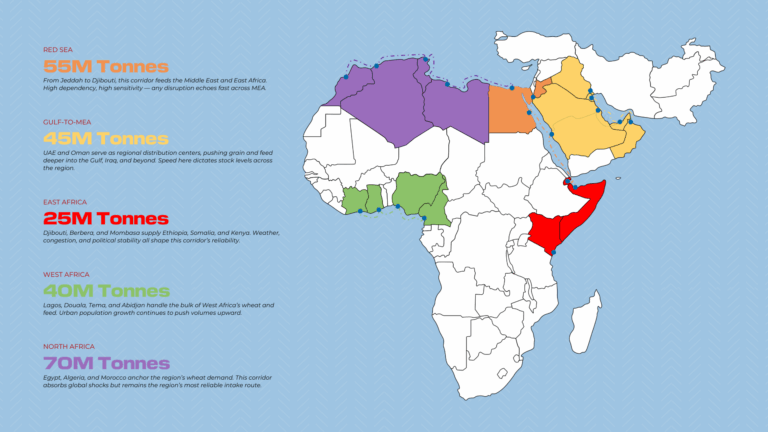
Across the Middle East and Africa (MEA), grain does not move randomly.
It moves through a handful of powerful, high-volume distribution corridors that determine whether wheat, corn, soybean meal, and feed ingredients arrive on time — or whether mills face slowdowns, shortages, and unstable intake.
In 2025, these corridors have become strategic lifelines for governments, feed mills, food producers, aid agencies, and traders navigating a turbulent global grain market.
At IMGS Group, our teams operate across ports, terminals, silos, warehouses, and inland networks throughout MEA. We see the realities of grain movement daily — the bottlenecks, the pressure points, the opportunities, and most importantly, the corridors that matter.
This insight breaks down the five major grain distribution corridors shaping MEA’s food and feed supply, why each one matters, and how IMGS Group supports operational flow across them.
1. Red Sea Corridor: The backbone of Middle Eastern and East African grain intake
From Jeddah to Aqaba, from Safaga to Djibouti, the Red Sea corridor is one of the most strategically sensitive grain routes in the world.
It supplies:
Saudi Arabia’s wheat and feed intake
Jordan’s milling sector
Egypt’s Red Sea-side demand
Ethiopia, Somalia, and regional food-security programs
Any disruption here — port congestion, vessel rerouting, weather delays — affects multiple regions within hours.
Why it matters:
The Red Sea corridor is the most interconnected food-security route in MEA.
Where IMGS fits in:
IMGS teams support vessel discharge, mobile bagging, portside distribution, and inland coordination across Red Sea gateways, helping stabilize intake for mills and agencies moving through this corridor.
2. Gulf-to-MEA Corridor: The GCC’s import engine and re-export hub
Through Jebel Ali, Khalifa Port, Sohar, Dammam, and onward to Iraq and Kuwait, the Gulf corridor drives the region’s commercial grain flow.
This corridor is:
Fast
Predictable
Storage-rich
Built for re-export
It handles everything from bulk wheat to soybean meal, corn, and specialty feed ingredients.
Why it matters:
What moves through the Gulf today feeds livestock tomorrow — and stabilizes feed mills from the Gulf to the Levant.
Where IMGS fits in:
With mobile bagging, marine agency, and multimodal storage support, IMGS strengthens throughput and reduces vessel-to-warehouse friction across Gulf ports.
3. East Africa Import Corridor: MEA’s most fragile and essential food-security route
Through Djibouti, Berbera, and Mombasa, this corridor feeds Ethiopia, Somalia, and Kenya — a region where population demand is rising faster than port capacity.
It carries:
Food aid wheat
Commercial wheat
Sorghum
Maize
Blended feed and humanitarian cargo
Why it matters:
Congestion or weather delays here affect some of the world’s most vulnerable markets.
Where IMGS fits in:
IMGS supports humanitarian and commercial logistics, improving discharge rates, bagging speed, and inland dispatch coordination across East Africa’s entry points.
4. West Africa Atlantic Corridor: Home to Africa’s fastest-growing consumption zones
Ports like Lagos, Douala, Tema, and Abidjan handle the majority of West Africa’s wheat and feed grain imports.
With urban populations rising and milling demand expanding, this corridor continues to accelerate.
Why it matters:
It is one of the most dynamic grain markets globally — but also one of the most challenging, with port congestion and inland distribution complexity increasing yearly.
Where IMGS fits in:
IMGS brings high-throughput mobile bagging, equipment deployment, and portside flow optimization to reduce vessel time and keep grain moving.
5. North Africa Mediterranean Corridor: MEA’s largest and most stable grain corridor
North Africa imports more wheat than any other MEA region.
Ports across Egypt, Algeria, Tunisia, and Morocco handle enormous annual volumes — driven by population size and national food-security programs.
Why it matters:
This corridor anchors MEA’s grain system.
Price stability, storage management, and intake reliability here ripple across the rest of the region.
Where IMGS fits in:
From marine agency to silo/warehouse operations, IMGS supports optimized discharge, storage flow, and grain-handling precision across the Mediterranean belt.
WHY THESE CORRIDORS MATTER
These five corridors determine:
Regional wheat pricing
Grain arrival timing
Feed stock stability
Port congestion levels
Supply chain resilience
Production planning for mills
Humanitarian aid distribution
Understanding these corridors is not just logistics —
it’s a strategic advantage for every miller, importer, trader, port operator, and government stakeholder.
As demand grows, climate volatility increases, and global maritime patterns shift, the MEA region will rely even more heavily on its strategic grain corridors.
The companies that understand these routes — and partner with experts who operate across them — will be the ones best positioned to navigate 2025 and beyond.
IMGS Group is proud to support the movement that feeds the Middle East and Africa.
RELATED SERVICES SIGHTS MEA Grain Distribution Corridors
Maximize your investment and competitive advantage with IMGS Group related services
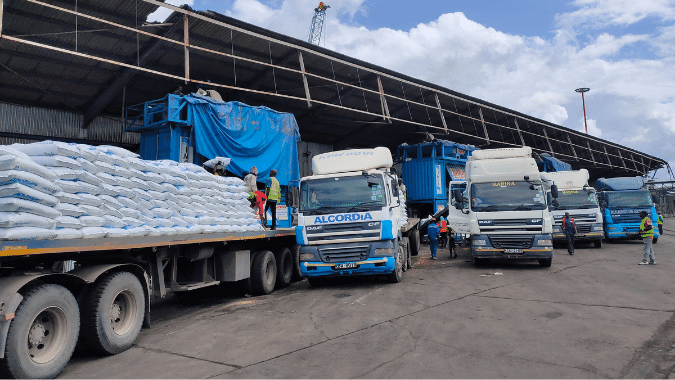
Inland Transporation
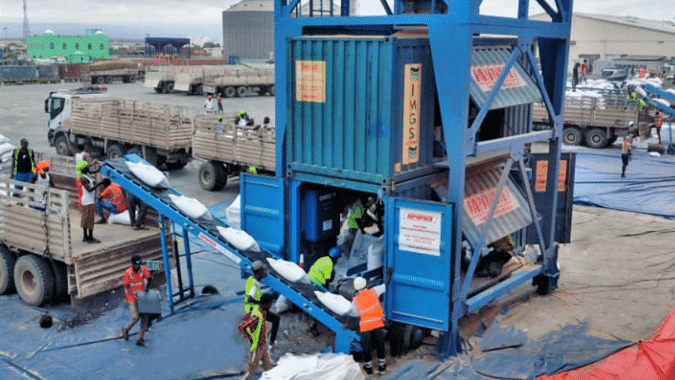
Mobile Bulk Bagging
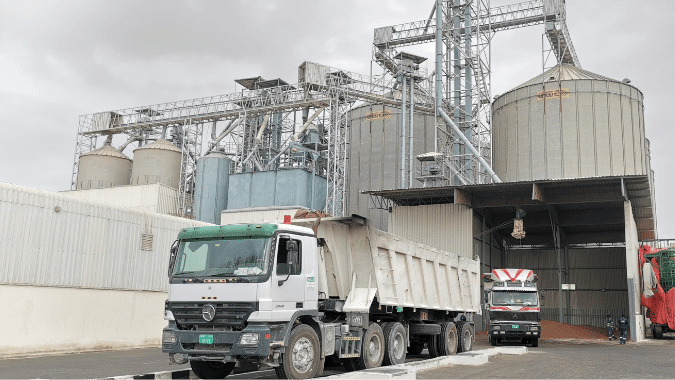
TERMINAL & SILO MANAGEMENT
Get your customized solutions now!